Guided Onboarding Experience

Product Design

Mobile App

User Testing

Year

2025

Client

FlaiChat

Role

Product Designer

FlaiChat is an AI-powered messaging platform that helps multilingual families and friend groups communicate naturally by translating conversations across languages in real time.

FlaiChat is an AI-powered messaging platform that helps multilingual families and friend groups communicate naturally by translating conversations across languages in real time.

Context

As an early-stage startup, our initial focus was driving app downloads. While acquisition was strong, we quickly noticed a steep drop-off between downloading the app and starting a user's first conversation.

As an early-stage startup, our initial focus was driving app downloads. While acquisition was strong, we quickly noticed a steep drop-off between downloading the app and starting a user's first conversation.

Rather than redesigning the entire experience, we identified onboarding as the fastest, highest-impact opportunity to test whether we could improve activation and build momentum for future iterations.

The opportunity

To understand where users were struggling, I combined product analytics with moderated user research and usability testing. I observed bilingual and trilingual participants across different ages and cultures, while also asking friends and family to screen record themselves using the app.

The patterns were consistent. Users rarely made it past onboarding. Rather than introducing FlaiChat's core value, the experience quickly shifted into secondary features like task management, location sharing, cloud backup, threaded messages, and QR codes before users had even created an account or sent their first message. Combined with an unfamiliar AI experience, many users abandoned the flow before reaching their first conversation.

To understand where users were struggling, I combined product analytics with moderated user research and usability testing. I observed bilingual and trilingual participants across different ages and cultures, while also asking friends and family to screen record themselves using the app.

The patterns were consistent. Users rarely made it past onboarding. Rather than introducing FlaiChat's core value, the experience quickly shifted into secondary features like task management, location sharing, cloud backup, threaded messages, and QR codes before users had even created an account or sent their first message. Combined with an unfamiliar AI experience, many users abandoned the flow before reaching their first conversation.

The challenge

The existing onboarding introduced multiple features before users understood the app's primary purpose: helping people communicate across language barriers with AI. It asked users to learn about backups, QR codes, location sharing, and threaded conversations before they had experienced the product's core value.

The challenge was simplifying onboarding into a guided experience that built trust in AI, prioritized the most important actions first, and helped users confidently reach their first conversation without overwhelming them.

The existing onboarding introduced multiple features before users understood the app's primary purpose: helping people communicate across language barriers with AI. It asked users to learn about backups, QR codes, location sharing, and threaded conversations before they had experienced the product's core value.

The challenge was simplifying onboarding into a guided experience that built trust in AI, prioritized the most important actions first, and helped users confidently reach their first conversation without overwhelming them.

Design principles & goals

  1. Trust is the first feature. Many users were encountering both AI and FlaiChat for the first time. Before asking them to create an account or invite others, the experience needed to build confidence by introducing AI in a familiar, approachable way.


  2. Guide, don't overwhelm. Rather than front-loading information, onboarding introduced concepts progressively through interactive steps, clear progress indicators, and contextual guidance that helped users learn by doing.


  3. Meet users where they are. FlaiChat serves people across generations, languages, and technical backgrounds. Every interaction prioritized accessibility, flexibility, and user control so experienced users could move quickly while others received additional guidance.

The solution
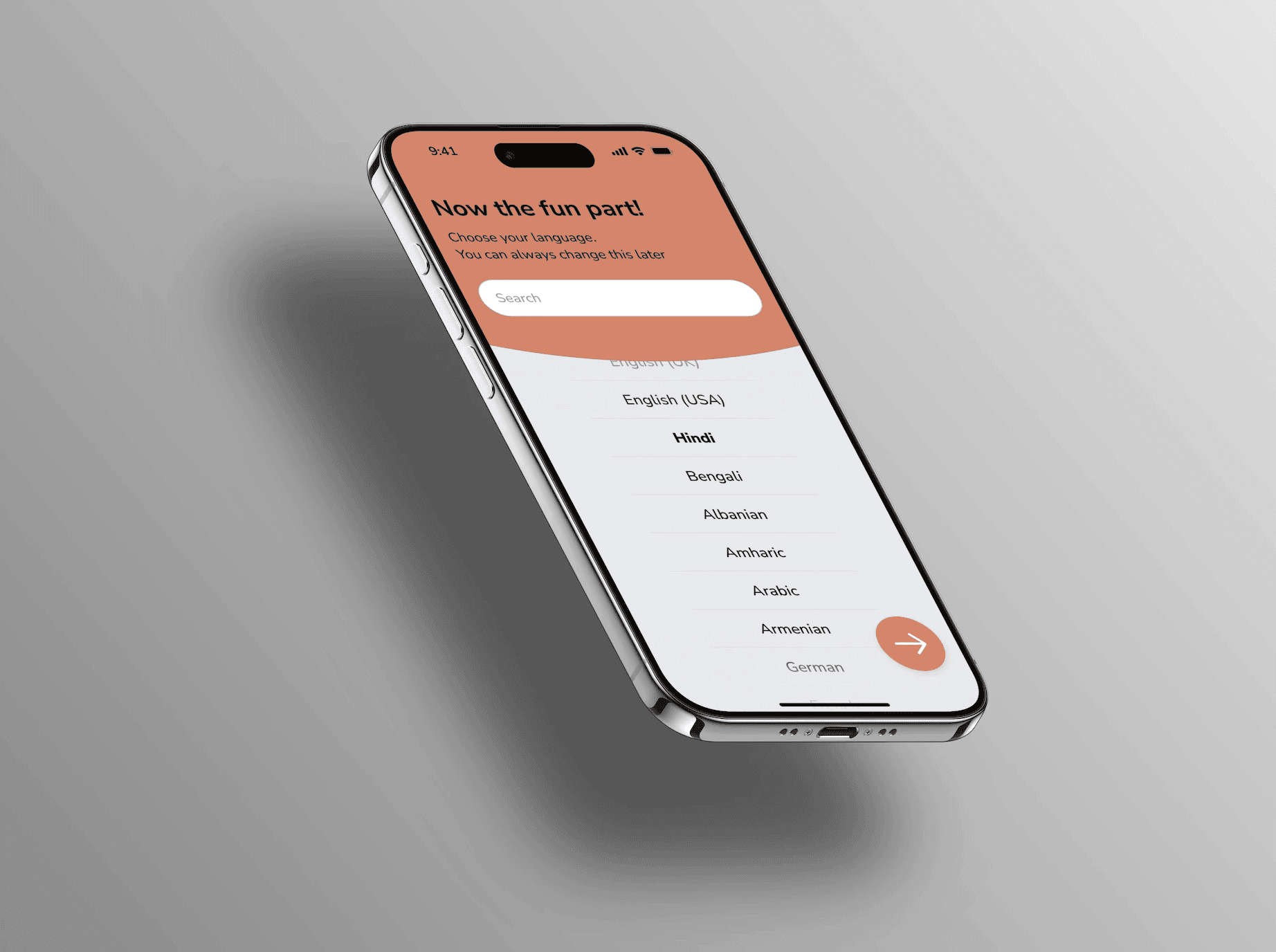
I redesigned onboarding around building confidence through action instead of explanation. Rather than immediately introducing secondary features, the new experience focused first on helping users understand FlaiChat's core purpose and how Flai, the app's AI assistant, could help them communicate across languages.

I redesigned onboarding around building confidence through action instead of explanation. Rather than immediately introducing secondary features, the new experience focused first on helping users understand FlaiChat's core purpose and how Flai, the app's AI assistant, could help them communicate across languages.

Feature education was intentionally reordered and progressively disclosed so users encountered information only when it became relevant. Interactive walkthroughs, lightweight animations, and guided setup replaced static explanations, while clearer profile creation, larger touch targets, simplified copy, and visible progress indicators reduced friction throughout the journey. Users could continue with a guided tutorial after creating an account or skip ahead at any point, giving both new and experienced users control over their experience.

Success Metrics

Success Metrics

Reduce user drop-off between app download and first conversation by increasing onboarding completion and account creation.

Reduce user drop-off between app download and first conversation by increasing onboarding completion and account creation.

0+

Usability sessions

0+

User interviews

0+

Screens redesigned

One of the most rewarding moments came when my grandmother, who primarily speaks Korean and had never used AI before, completed both the original onboarding and my redesigned experience. After finishing the new flow, she said:


네가 옆에서 하나씩 알려주는 것 같았어.

It felt like you were right there showing me what to do.

Kim Min

Kayla's Grandma

One of the most rewarding moments came when my grandmother, who primarily speaks Korean and had never used AI before, completed both the original onboarding and my redesigned experience. After finishing the new flow, she said:


네가 옆에서 하나씩 알려주는 것 같았어.

It felt like you were right there showing me what to do.

Kim Min

Kayla's Grandma

One of the most rewarding moments came when my grandmother, who primarily speaks Korean and had never used AI before, completed both the original onboarding and my redesigned experience. After finishing the new flow, she said:


네가 옆에서 하나씩 알려주는 것 같았어.

It felt like you were right there showing me what to do.

Kim Min

Kayla's Grandma

Reflection

This project changed how I think about onboarding. The real challenge wasn't teaching users everything about AI. It was giving them enough confidence to take the first step.

Looking back, I would have loved to extend the experience beyond onboarding and guide users through their first live conversation inside the app. Given our timeline, we intentionally focused on validating the highest-friction part of the journey first. That decision reinforced the importance of solving one meaningful problem well before expanding the scope.

This project changed how I think about onboarding. The real challenge wasn't teaching users everything about AI. It was giving them enough confidence to take the first step.

Looking back, I would have loved to extend the experience beyond onboarding and guide users through their first live conversation inside the app. Given our timeline, we intentionally focused on validating the highest-friction part of the journey first. That decision reinforced the importance of solving one meaningful problem well before expanding the scope.

Discover other projects

A collection of innovative projects, where creativity and strategy meets cutting-edge technology to solve real-world challenges.